


Mount Rainier, Washington State, stands at 4,323 meters, towering far above the surrounding peaks that rise to only about 1,800 meters. From Seattle, hundreds of mountains are visible, yet when people refer to "the mountain," everyone knows they mean Mount Rainier. For over a century, Mount Rainier has deeply captivated mountaineering enthusiasts from around the world.
Mount Rainier is an active volcano. Indigenous peoples called it "Tahoma" (meaning "God's Mountain"). In 1792, British navigator George Vancouver first recorded it and named it after a friend. In 1888, John Muir completed the first successful ascent.
Mount Rainier has the largest glacial system in the contiguous United States, outside Alaska. The meltwater from its glaciers nourishes five major rivers, which eventually flow into Puget Sound, sustaining salmon and temperate rainforests along the way.
Due to climate change, the glaciers on Mount Rainier are retreating at a not-insignificant pace. But for now, it remains a spectacular expanse of snow and ice at this latitude.
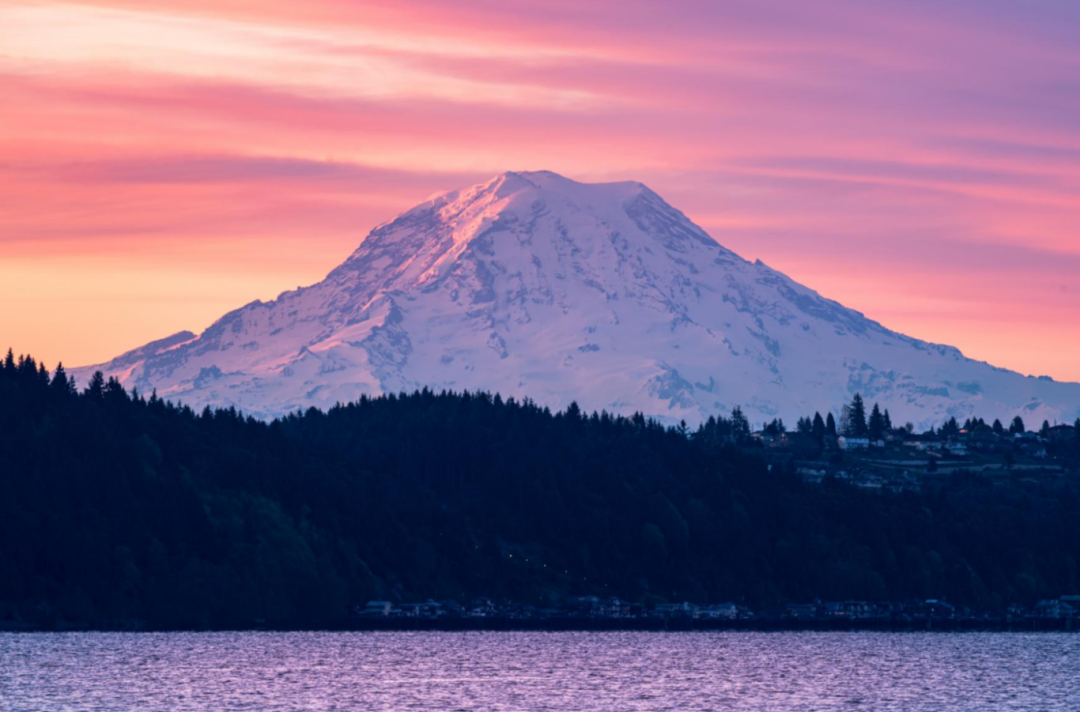
Image source: Tuchong
From late July to August, Mount Rainier offers breathtaking scenery. The high-altitude snow has not yet completely melted, but the meadows are already bursting with wildflowers—lupines in purplish-blue, paintbrush in orange-red, along with vast patches of white daisies and yellow marigolds. Against this backdrop stand the perpetually snow-capped peaks and gray volcanic rock. This unique combination of "glaciers and flower fields" is rarely seen elsewhere on Earth.
Editor Ⅰ: Zhang Congxiao
Editor Ⅱ: Bao Gang
Editor Ⅲ: Pan Kaiyue