


Southern Guangxi
The "Old Friend Flavor" and Lively Human Touch of the Hot and Humid Climate
Heading south along the Liujiang River, you arrive at Nanning, the capital of Guangxi. The climate here is hot and humid, and people need a type of food that can both stimulate the appetite and induce perspiration to cool the body—thus, Laoyou Fen (Old Friend Rice Noodles) came into being.
There is a warm legend in Nanning about the origin of Laoyou Fen. In the 1930s, an elderly man was bedridden with a cold. His good friend visited him daily and ordered a bowl of noodles for him at a tea house, stir-frying pickled bamboo shoots, chili peppers, fermented black beans, and minced garlic before adding broth to make a soup. After eating this for several days, the old man recovered from his cold, and he named the dish "Laoyou Mian" (Old Friend Noodles). Later, the noodles were replaced with rice noodles, giving rise to today's "Laoyou Fen." The term "Laoyou" (old friend) reflects the city character of Nanning—valuing friendship and loyalty.
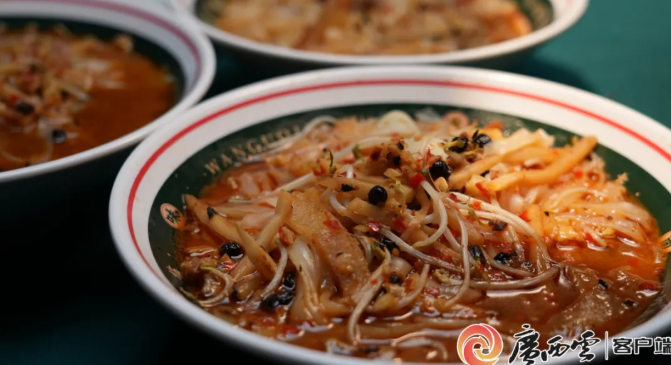
Laoyou Fen. Source: Guangxi Cloud - Guangxi Daily, Photo by Gan Yanxia
Laoyou Fen is prepared by stir-frying and cooking on the spot. Pickled bamboo shoots, minced garlic, fermented black beans, and pickled chili peppers are stir-fried in a wok, followed by the addition of pork offal or beef, then boiling broth, and finally sliced rice noodles. The entire process is completed within three to four minutes—a common "flame-and-wok show" on the streets of Nanning. The fire roars, the wok flips, and the sour, aromatic, and spicy fragrance fills the air with steam.
In Pumiao Town, Yongning District, Nanning, Shengzha Mixian (fermented rice noodles) is another centuries-old tradition. Its distinguishing feature is a "slightly sour" taste—an aroma produced by the slight natural fermentation of ground rice milk. Some call it a "sourdough smell," but it is an unforgettable "taste of home" for locals. The fermentation process of Pumiao Shengzha Mixian is closely tied to the local hot and humid climate. High temperatures and humidity accelerate microbial activity, allowing the rice milk to ferment in a short time. This wisdom of "adapting to local conditions" is similar to the "using spice to ward off dampness" philosophy behind Laoyou Fen. Shengzha Mixian is served with minced pork, dried tofu, and peanuts. Though simple in appearance, it carries over a century of culinary memory, and its craftsmanship has been inscribed on the autonomous region-level intangible cultural heritage list.
Eastern Guangxi
The "China's Unique Specialty" That Emerged from the Deep Mountains
Heading east from Nanning into eastern Guangxi, the Dayao Mountains and Daguishan Mountains rise in layered succession. On this rugged land, Luoxiu Mixian, hailed as "China's Unique Specialty," was born.
Luoxiu Mixian is produced in Luoxiu Town, Guiping City, with a history of nearly 200 years. It gained fame as early as the early Ming Dynasty and was once listed as a tribute item. Luoxiu Town is surrounded by mountains with a basin-like topography, featuring warm winters and cool summers. This unique geography and climate cause the same variety of early indica rice to have a longer maturation cycle than in neighboring towns. In 1985, China Central Television featured Luoxiu Mixian in its program China's Unique Specialty: 150 strands of rice noodles (approximately 200 grams) were able to suspend a 70-kilogram person swinging on them.
The creation of Luoxiu Mixian is also closely related to the ancient reality of Luoxiu's "high mountains, steep slopes, and inconvenient transportation." Local residents needed a portable, quick-cooking, and hunger-sustaining dry food for trips to markets or when working as porters. Thus, fresh wet rice noodles were dried into bundles, ready to be rehydrated with boiling water when eaten. This represents an early form of "modern instant rice noodles." The craftsmanship of Luoxiu Mixian has been inscribed on the autonomous region-level intangible cultural heritage list, with an annual production exceeding 25 million kilograms, distributed to Guangzhou, Shenzhen, and Southeast Asia.
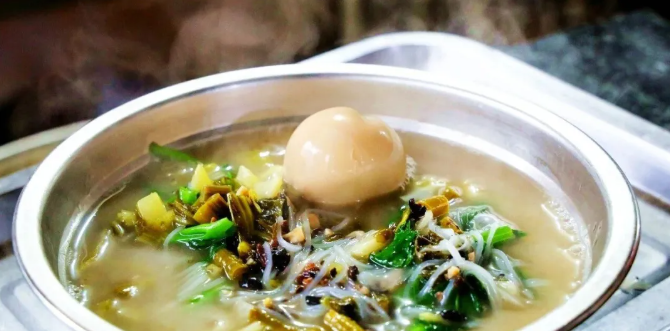
Luoxiu Mixian. Source: Guiping Convergence Media Center
Following the Xijiang River eastward, Wuzhou is Guangxi's "East Gate," sitting along the golden waterway of the Xijiang River and serving as a key water transport hub between Guangdong and Guangxi since ancient times. Wuzhou Shangtang River Noodles reflect the culinary landscape of this commercial port city. The sliced rice noodles are thin and wide, the broth is simmered from pork and chicken bones, and toppings include roast duck, barbecued pork, beef brisket, and various other choices. The Xijiang River shipping trade brought merchants from north and south, along with a fusion of regional flavors. The inclusiveness of Wuzhou Shangtang River Noodles serves as the culinary footnote to this century-old commercial port.
Editor Ⅰ: Zhang Congxiao
Editor Ⅱ: Zhang Wenwen
Editor Ⅲ: Pan Kaiyue