

Alaska has long been considered a place where people can "disappear" off the grid for any number of reasons. It makes perfect sense, then, that in the 21st century the Last Frontier is now one of the first places advisors might think of for clients who are seeking a "digital detox" trip.
Considering how reliant our society has become on constant WiFi connection for work and play, it's not surprising that there is pushback against being so "plugged in" -- and many clients are turning to travel advisors to guide them on their journey to disconnect. You've heard of FOMO, or fear of missing out. This is JOMO: joy of missing out.
"We see a lot of executives who come here intentionally to unplug or who admit they need to be 'forced to' [unplug]" said Jordan Sanford, president of Doyon Tourism, a subsidiary of the Alaska Native corporation that owns and operates Kantishna Roadhouse. "Others struggle with the idea at first, but almost everyone ends up saying they're glad [connectivity] wasn't an option. That sense of separation becomes part of the experience itself."
Kantishna, located within the far reaches of Denali National Park, is joining other properties across Alaska that are leveraging their lack of WiFi to market the restorative benefits of stepping away from technology and into nature.
"At Kantishna Roadhouse, the idea of disconnecting to reconnect really defines what guests experience," Sanford said. "Once they reach the end of the Denali Park Road, they've truly stepped off the grid. No WiFi, no cell service, just space to slow down and be present."
Stillpoint Lodge, a two-Michelin-key resort in Halibut Cove, sees about 5% of guests who fully opt out of WiFi each summer, with another 35% selectively disconnecting from personal devices for at least a portion of their stay at the property, located not far from Kenai Fjords National Park.
"We rarely see phones at dinner," said Beka Thoning, manager of Stillpoint Lodge. "Stillpoint's digital-detox program is truly authentic and rooted in the earliest vision for this special place. Guests aren't told to unplug -- they're inspired to. [Offering digital-detox stays] wasn't a marketing decision, it was a lifestyle choice that naturally became part of our hospitality philosophy."
Thoning tells me that even though WiFi and cell service are available at her property, guests quickly lose interest in staying connected once they arrive in Alaska.
"The surroundings provide ample stimulation for every sense: abundant wildlife, breathtaking scenery and a remarkable stillness that draws people in," she said. "Even those who intend to stay plugged in often find themselves slowing down and fully embracing the peaceful rhythm of the lodge after just a short time. Offline is such a luxury."
And it's not just busy executives who are seeking the extremes of an Alaskan adventure to go full airplane mode.
"Families come for similar reasons," said Sanford. "Parents want their kids to see Alaska without screens, to connect through shared experiences instead of notifications. For Alaskans, that kind of time outdoors feels familiar. For many visitors, it's something they didn't realize they were missing."
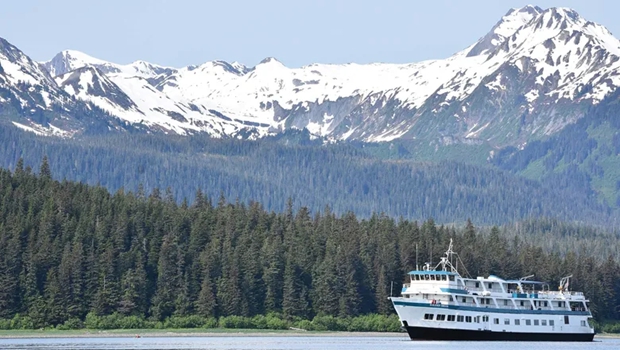
The Admiralty Dream sailing in Alaska. Indigenous-owned Alaskan Dream Cruises offers no WiFi onboard, describing their voyages as “a time to unplug and enjoy nature.” Photo Credit: Alaskan Dream Cruises
Serenity at sea
Lodges aren't the only option when it comes to unplugging in Alaska. Both Alaskan Dream Cruises and Maple Leaf Adventures are small-ship operators that prioritize authentic, local and conservation-focused experiences in the destination over internet connectivity.
Maple Leaf Adventures describes their remote wilderness sailings as "unplugged" on their website, with no internet access and little to no cell reception. Indigenous-owned Alaskan Dream Cruises similarly offers no WiFi onboard, describing their voyages as "a time to unplug and enjoy nature."
Satellite phones are onboard in case of emergency, but they are not accessible to guests.
Alaska's eight national parks are among its most glorious off-grid tourist offerings, and the state is home to two of the most remote national parks in the country. Clients looking to really get away can do so at Port Alsworth in Lake Clark National Park or the ultimate remote destination, Gates of the Arctic National Park (preferably for a guided daytrip as it has no campgrounds, road access or visitor services).
But there's no need to journey into the Arctic just for some peace and quiet. Popular Alaska cruise turnaround port Seward offers access to Kenai Fjords National Park. Aside from WiFi available at park headquarters, there is no cell reception bouncing around the roughly 1,000 square miles of the park, which hosts frequent wildlife- and glacier-viewing cruises during the spring and summer seasons.
Editor Ⅰ: Zhang Congxiao
Editor Ⅱ: Bao Gang
Editor Ⅲ: Liu Guosong