

On September 28, the Huajiang Canyon Bridge—part of the Liuzhi-Anlong Expressway and spanning Zhenfeng County and Guanling County in Guizhou Province—officially opened to traffic as the world's tallest bridge. Boasting two world-first titles, the super bridge features a 1,420-meter main span (the longest among mountain bridges globally) and a 625-meter vertical drop from deck to water (the highest bridge height worldwide), serving as a crucial hub connecting the Liuzhi-Anlong Expressway.
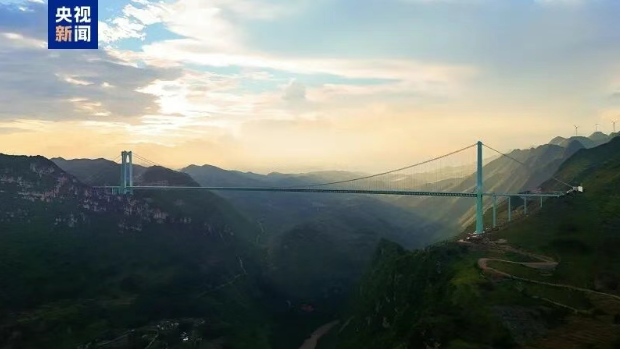
Image source: CCTV
From 2 Hours to 2 Minutes: A Barrier Transformed
Stretching 2,890 meters across the Huajiang Grand Canyon, known as the "Earth's Rift Valley," the bridge has revolutionized cross-canyon travel. What once took a 2-hour detour between Zhenfeng and Guanling counties now takes just 2 minutes, truly turning a perilous chasm into a smooth route.
Tech-Enabled "Smart Nerves" for the Bridge
Facing the natural challenges of the deep canyon, constructors employed a range of innovative technologies during construction. The most notable is the "smart cable" embedded in the main cable—three fiber Bragg grating sensors that real-time monitor stress, temperature, and humidity data. As the "lifeline" of the suspension bridge, the main cable cannot be replaced once installed. Unlike traditional monitoring methods that infer stress through deformation, the "smart cable" enables 24/7 dynamic monitoring. When humidity exceeds 64%, dehumidifiers automatically activate, effectively preventing corrosion caused by condensation in enclosed spaces and ensuring the bridge's 100-year service life.
Lightweight yet Heavy-Duty: Forged-Welded Cable Saddle
To cope with the immense pressure from the 1,420-meter super span, the engineering team broke free from traditional casting processes and adopted a forged-welded cable saddle for the first time. After tens of thousands of precision forging operations, the maximum single weight of the saddle was reduced to 41.3 tons while its compressive strength increased by 44%. This innovative process not only lightens the structure but also simplifies transportation and hoisting, achieving true "lightweight load-bearing."
Turning Stones into Gold: Material Revolution for 160,000-Cubic-Meter Anchors
The bridge's anchors—comparable to "stable feet"—each require 160,000 cubic meters of concrete. During construction, the team innovatively ground dolomite gravel from roadbed excavation into powder to replace scarce fly ash. After three months of repeated proportioning tests, this "local material utilization" approach saved approximately 5 million yuan in material costs, embodying a modern-day "turning stones into gold."
Bridge-Tourism Integration: A New Landmark for Guizhou
From the outset, the bridge's design emphasized integration with surrounding tourism resources, adhering to the concept of "creating attractiveness on the bridge and productivity under the bridge" to pioneer a world-class model of bridge-tourism integration. Beyond serving as a vital transportation artery, the canyon-spanning bridge will become a new engine for enriching local communities on both banks. From Beidou navigation-assisted construction and drone-based high-altitude operations to intelligent monitoring and the application of ultra-high-strength materials, the constructors of the Huajiang Canyon Bridge achieved millimeter-level precision at 600 meters above the ground over three years, contributing another example of "Chinese wisdom" to global bridge engineering.
Editor Ⅰ: Zhang Wenwen
Editor Ⅱ: Bao Gang
Editor Ⅲ: Liu Guosong