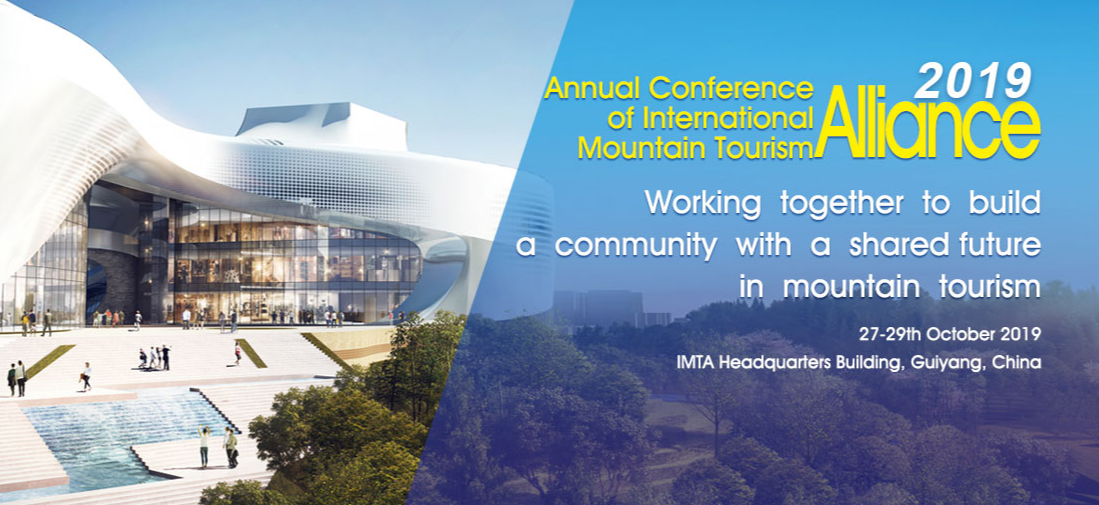


Editor's Note: On November 11, the International Conference of Mountain Tourism and Outdoor Sports (MTOS) 2025 commenced in Guiyang City, Guizhou Province. With the continued theme "Integration of Culture, Tourism and Sports Presents a High Quality Life," this year's Conference featured a series of events including the International Mountain Tourism Alliance (IMTA) Annual Conference 2025, the International Mountain Tourism Promotion Conference 2025, a Field Trip to Guizhou Mountain Tourism Destinations, and the Bank of Guizhou·Mountain Culture, Tourism and Outdoor Sport Equipment Exhibition. Over 350 participants gathered, including representatives from international organizations, government and tourism departments of relevant countries, diplomatic missions in China, tourism-related enterprises, mountain tourism destination management agencies, experts, scholars, and media from more than 30 countries and regions. They explored new pathways for the integrated development of "Mountain Tourism +", shared new achievements in mountain tourism development, and worked together to build a prosperous new future for mountain tourism. Xu Jing, former Regional Director for Asia and the Pacific, UNWTO, IMTA Individual Director and member of the Expert Committee, released the special publication of Innovation in Mountain Tourism and Community Co-development on behalf of the IMTA.

The following is the full text of the publication:
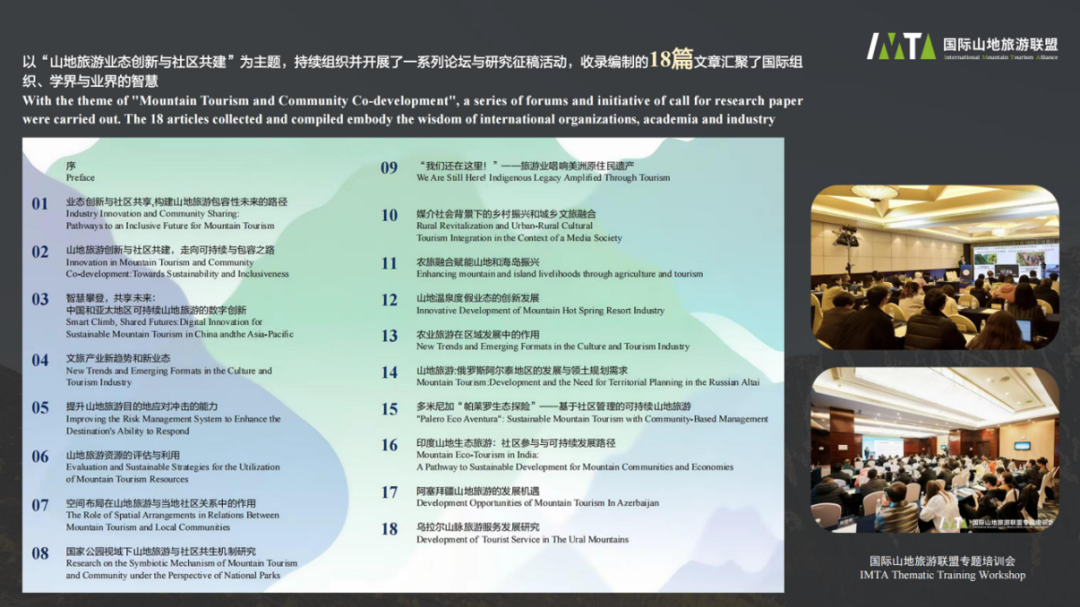
Ladies and gentlemen, distinguished guests, Good morning. It is my privilege to present the Special Publication on Innovation in Mountain Tourism and Community Co-development at the 2025 International Mountain Tourism Alliance (IMTA) Annual Conference, under the IMTA's mandate. Since 2023, the IMTA has spearheaded forums and research activities under the theme "Innovation in Mountain Tourism and Community Co-development," continuously organizing a series of forums and research programs that bring together the wisdom of international organizations, academia, and the tourism industry and pioneering sustainable approaches centered on cultural preservation, technology empowerment, and social collaboration.
Innovation in mountain tourism is not only reflected in the renewal of product forms and business models but also in the redefinition of value, a shift from the pursuit of tourist traffic and consumption towards an increasing emphasis on cultural depth, ecological balance, and social responsibility. Community co-development, meanwhile, represents a new ethic in the development of mountain tourism. It transforms destination residents from passive participants into active contributors, achieving coordinated growth in economic, social, and environmental benefits.
This special publication is the result of that shared vision, offering readers authoritative insights into global best practices and theoretical advancements regarding innovation in mountain tourism and community co-development.
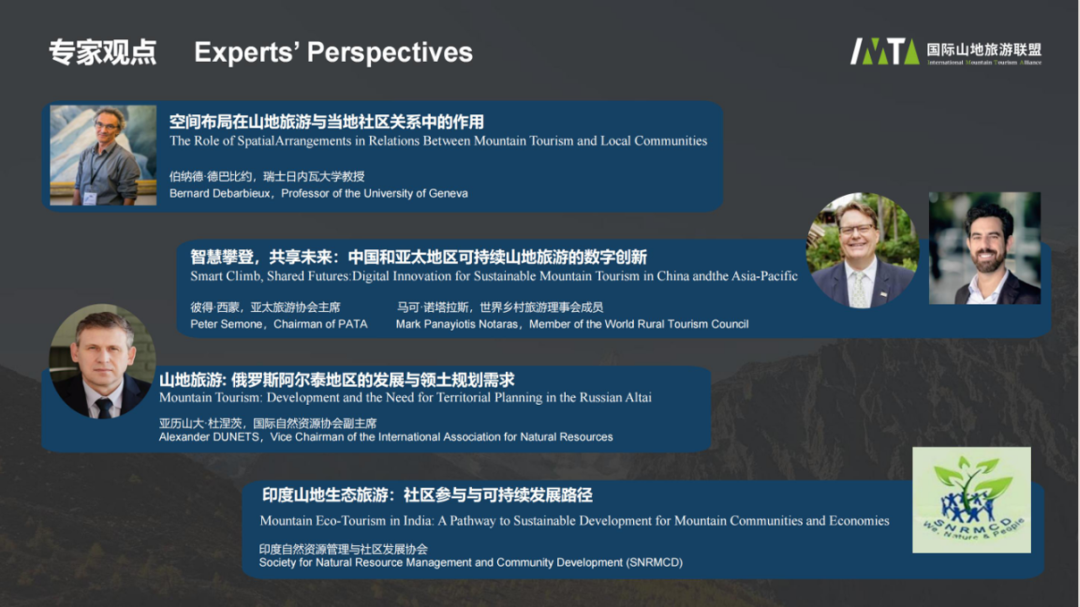
Swiss scholar Bernard Debarbieux analyzes the diverse patterns of relationships between mountain tourism and communities from a spatial-structural perspective. He puts forward the important proposition that "the organization of space determines the quality of social relations," providing a solid theoretical foundation for understanding the mechanisms of tourism-community symbiosis.
Peter Semone, Chairman of the Pacific Asia Travel Association (PATA), and expert Mark Panayiotis Notaras approach the subject from the perspective of digital innovation, demonstrating how smart technologies can empower sustainable mountain tourism and enhance both environmental protection and community well-being.
Alexander Dunets, Professor at Altai State University, Russia, illustrated the significance of defining priority sectors and strategic directions for mountainous regions, drawing on development and territorial planning needs from Russia's Altai region.
Research by the Indian Society for Natural Resource Management and Community Development, based on empirical cases in Uttarakhand and Meghalaya, reveals how ecotourism has become an effective means of promoting women's employment and improving local governance, highlighting the decisive role of community participation in sustainable tourism.
These research achievements not only underpin the sustainable development of mountain tourism with solid theoretical foundations but also offer replicable operational models for mountain tourism programs worldwide.
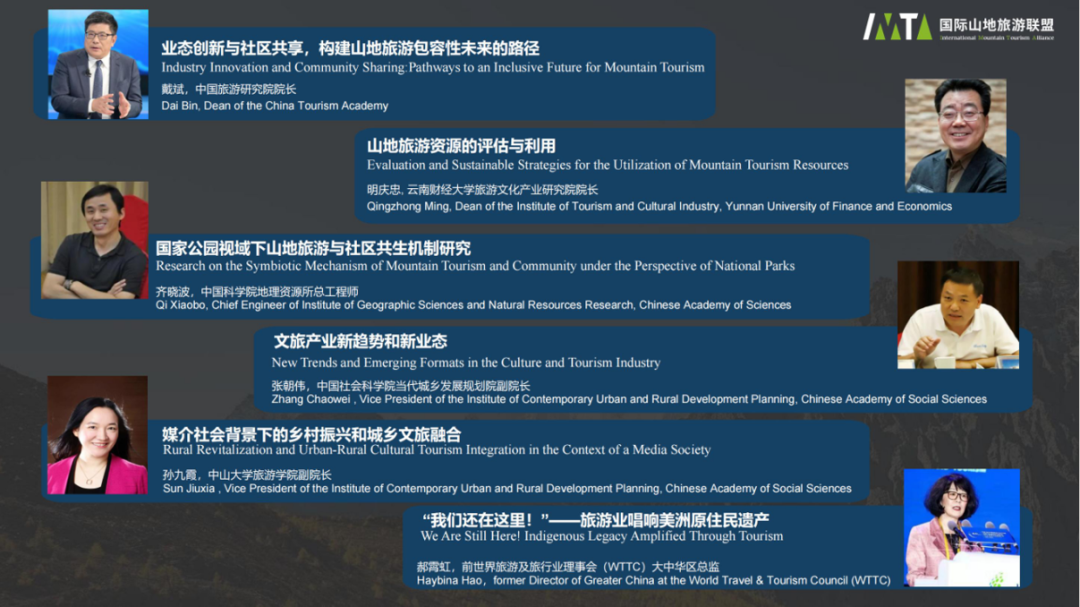
Professor Dai Bin, President of the China Tourism Academy, in his paper "Innovation and Shared Development: Building an Inclusive Future for Mountain Tourism," profoundly elaborates the concept of inclusive growth. He emphasizes that the value of mountain tourism lies not merely in resource development, but in ensuring that the outcomes of development benefit local communities and give back to nature.
Ming Qingzhong, Dean of the Institute of Tourism and Culture Industry of Yunnan University of Finance and Economics, provides a scientific framework for measuring and evaluating mountain tourism resources, offering a methodological foundation for industrial development; Qi Xiaobo, Chief Engineer of the Tourism Research and Planning Design Center of the Institute of Geographic Sciences and Natural Resources Research, Chinese Academy of Sciences, taking national parks as a case, explores the symbiotic mechanism of "park–community partnerships," demonstrating a uniquely Chinese approach to mountain governance; Zhang Chaowei, Deputy Head of the Institute of Modern Urban-Rural Development Planning of the Chinese Academy of Social Sciences, applies the concept of "holistic leisure" to depict a new pattern of cultural and tourism integration, revealing how mountain tourism serves as a bridge between urban regeneration and rural revitalization; Sun Jiuxia, a professor at the School of Tourism Management, Sun Yat-sen University, from the perspective of media and communication, explores innovative approaches to cultural-tourism integration under the context of rural revitalization, emphasizing the empowering role of media in enhancing urban-rural cultural interaction, shaping community identity, and promoting public participation; Haybina Hao, Former Director of Greater China for the World Travel & Tourism Council (WTTC), focusing on Native American heritage, reveals the unique value of cultural tourism in fostering intercultural dialogue and empowering marginalized groups, highlighting a global and humanistic vision that "lets culture speak for itself."
This special publication not only showcases the scholarly insights and practical accomplishments of the IMTA's global think tank platform but also marks a pivotal milestone as mountain tourism embraces a new era of collaboration, participation, and common interests. The accomplishments featured in this special publication demonstrate significant theoretical and practical contributions across resource evaluation, governance mechanisms, cultural-tourism integration, and cultural empowerment. These achievements will serve as valuable references for practitioners while mobilizing broader societal engagement in advancing mountain tourism.
In this new era of collaboration, participation, and common interests, we anticipate translating these research achievements into concrete actions to foster sustainable and dynamic growth in mountain tourism. This will position mountain tourism as a pivotal driver of regional economic prosperity, social well-being, and ecological conservation. Guided by the IMTA, let us unite our efforts to pool collective wisdom, embody the principle of "innovation in mountain tourism and community co-development" in both thought and practice, and collaboratively shape a more prosperous, inclusive, and sustainable future for mountain tourism. Thank you!
Image and text source: IMTA
Editor Ⅰ: Zhang Wenwen
Editor Ⅱ: Bao Gang
Editor Ⅲ: Liu Guosong