

Editor's Note: On November 11, the International Conference of Mountain Tourism and Outdoor Sports (MTOS) 2025 commenced in Guiyang City, Guizhou Province. With the continued theme "Integration of Culture, Tourism and Sports Presents a High Quality Life," this year's Conference featured a series of events including the International Mountain Tourism Alliance (IMTA) Annual Conference 2025, the International Mountain Tourism Promotion Conference 2025, a Field Trip to Guizhou Mountain Tourism Destinations, and the Bank of Guizhou·Mountain Culture, Tourism and Outdoor Sport Equipment Exhibition. Over 350 participants gathered, including representatives from international organizations, government and tourism departments of relevant countries, diplomatic missions in China, tourism-related enterprises, mountain tourism destination management agencies, experts, scholars, and media from more than 30 countries and regions. They explored new pathways for the integrated development of "Mountain Tourism +", shared new achievements in mountain tourism development, and worked together to build a prosperous new future for mountain tourism. Alexander Dunets, Vice President of the International Association of Natural Resources, made a presentation at the 2025 International Mountain Tourism Promotion Conference.
The following is the full text of the presentation:
Dear colleagues! My name is Alexander Dunets. I am from the Altai Mountains, a cross-border region that exemplifies cooperation between Russia and China. Today, I will discuss the potential of mountain tourism in Russia. My country is not only vast plains but also home to diverse destinations for tourists who love mountains.
Traditionally, Russia is considered a flat country. However, mountains occupy a significant quarter of our territory. These are not low hills: 70 peaks exceed 4,000 meters, and Mount Elbrus, our highest point, is also the highest peak in all of Europe. This gigantic landscape potential creates ideal conditions for trekking, mountaineering, and alpine skiing.
On this slide, the plain administrative entities are marked in dark green. You can see that many regions are, in fact, mountainous.
Tourist potential is developed extremely unevenly across Russia's mountains. The Caucasus, the Urals, and Altai are the most developed, while many mountains in Siberia and the Far East remain unknown to most tourists. The main mountain destinations are listed here.
Recognizing this imbalance, the Russian government has declared 2025 and 2026 the Years of Mountain Tourism. This strategic initiative is supported by the national "Tourism and Hospitality Industry" project, which aims to create infrastructure and develop master plans for tourist spaces across the country.
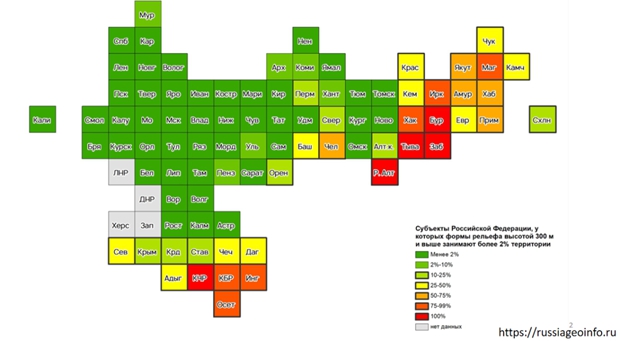
Administrative regions of Russia where mountains occupy more than 2% of the area
We classify the tourist space in Russia's mountainous regions by its level of organization, determined by infrastructure development, tourist flow intensity, and the nature of development.
You can see 5 types:
- Pioneer development: Remote protected areas with minimal infrastructure and a basic network of routes.
- Extensive development: Poorly developed localities connected by route networks; a zone requiring investment in basic infrastructure.
- Intensive development: Tourist areas with a high recreational load and developed infrastructure.
- Tourist-urbanized territories: Areas where tourism is integrated into existing industrial or agricultural landscapes.
- Innovative development: Advanced growth zones where competitive tourist clusters are created, implementing cutting-edge technologies and sustainable practices.
We can identify several criteria for differentiating tourism in Russia's mountainous regions. Firstly, the geographic location, hypsometric (terrain elevation), and climatic features. The level of economic development and population density also have a significant impact.
You can see the main types of mountain tourism in Russia on this slide.
The development of hiking has traditionally been a priority in Russia. Creating a network of national trekking routes is a key project. This map shows that the most favorable areas are in the country's southern part. The most popular regions are the Caucasus, the Southern Urals, Altai, the Sayan Mountains, the ranges near Lake Baikal, and the southern Far East.
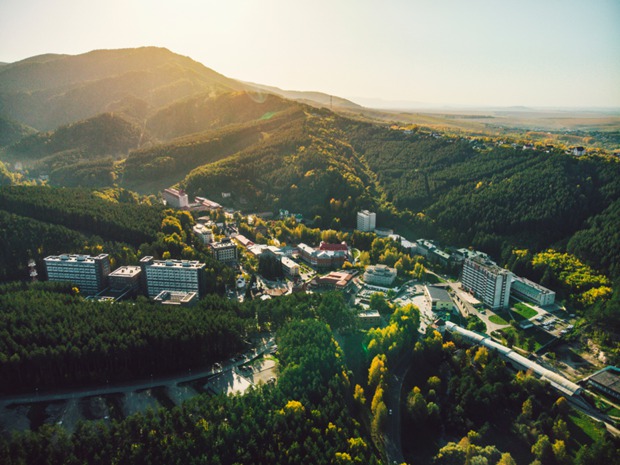
Belokurikhinsky Mountain Range (Russia)
The alpine skiing segment has shown significant growth over the past decade. However, with 1,300 km of slopes and 330 resorts, the overall development level is far from saturation. The leader is Sochi in the Western Caucasus, thanks to its Olympic heritage and superior transport accessibility. The Urals and the Kemerovo region also have well-developed winter infrastructure and are very popular.
Let me highlight the main mountain regions. The North Caucasus is the flagship of trekking and alpine skiing. Resorts like Krasnaya Polyana, Dombay, Prielbrusye, and Arkhyz are all-season international-level centers. This is also home to Mount Elbrus, the heart of Russian mountain tourism, which attracts adventurers from all over the world.
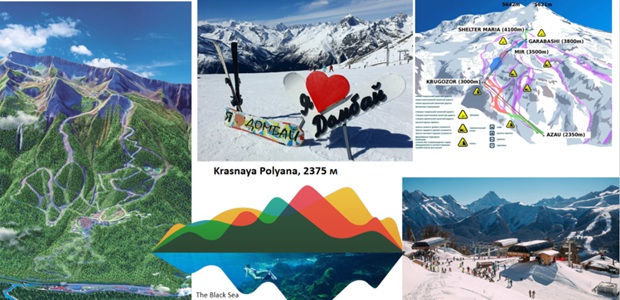
The North Caucasus: the flagship of trekking and mountain skiing tourism
The Ural Mountains are the longest in Russia. They are characterized by a strong level of economic development and diverse tourism offerings. The main advantage of the Urals is their proximity to major cities, making them an ideal destination for mass, family, and weekend tourism with a well-developed network of routes and centers.
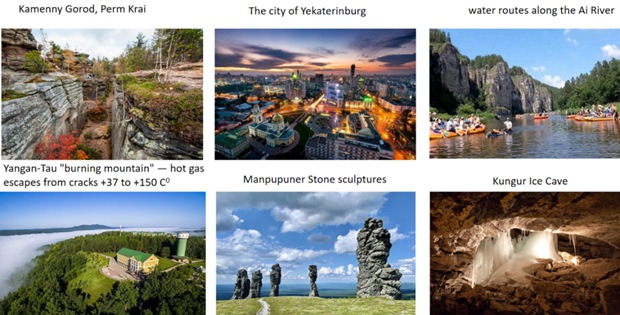
Ural Mountains (more than 2000 km): accessibility and diversity
Altai is a destination for those seeking a deep ethnographic and ecological experience. These mountains are the cradle of the Turkic peoples. UNESCO sites like Mount Belukha and Lake Teletskoye are highlights. Denisova Cave, where a new ancient human species was discovered, has rewritten the history of human development. Recent tourism growth has spurred the creation of modern tourist centers here.
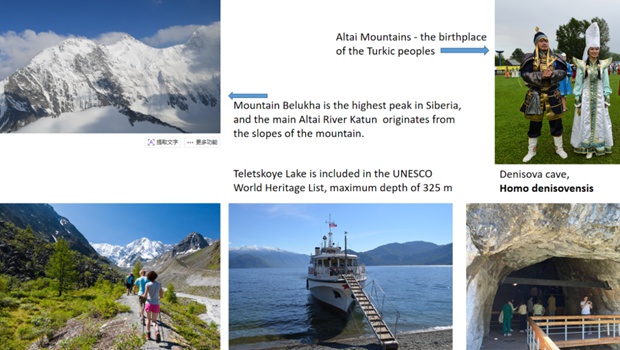
Altai
Other mountains of Southern Siberia, the Sayans, and the Baikal ranges, continue the theme of pristine nature and ethno-tourism. These areas feature many significant sites: ancient healing places, trails in national parks, the sacred Mount Alkhanai, the ancient Oglakhta petroglyphs, and the mystical Olkhon Island on Lake Baikal. This is a destination for true connoisseurs of wild, mountainous nature.
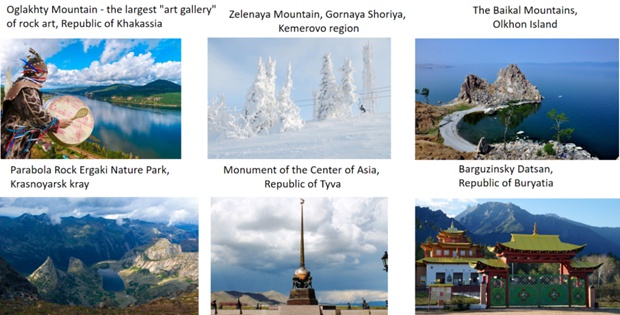
Sayan Mountains and Baikal Mountains : nature-oriented and ethnographic tourism
I must also mention the remote and hard-to-reach mountains of the North and East. The Lena Pillars, Kamchatka's volcanoes, and the Putorana Plateau are premium destinations for eco-tourism and adventure. The high cost and complex logistics are compensated by absolutely unique landscapes.
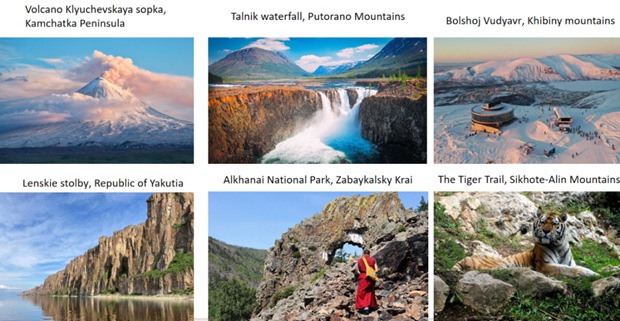
Mountains of the Russian North and East: wildlife and ecotourism
In conclusion, here are the main development vectors for Russian mountain tourism:
- Combating seasonality through all-season resorts and multi-activity recreation.
- Digitalization of services, from mobile apps to AI for resort management.
- Creating comfortable and diverse infrastructure for all tourist categories.
- A visible trend in every region is establishing new, high-quality hiking trail networks.
- The government's strategy involves creating master plans for tourist spaces that adhere to ESG principles.
Thank you for your attention!
Image source: International Association of Natural Resources
Editor Ⅰ: Zhang Wenwen
Editor Ⅱ: Bao Gang
Editor Ⅲ: Liu Guosong